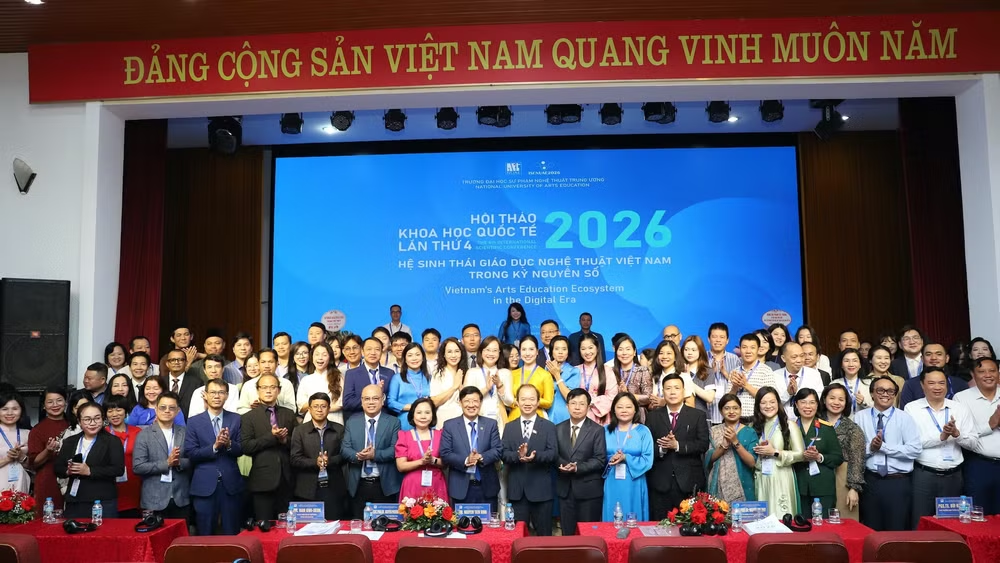
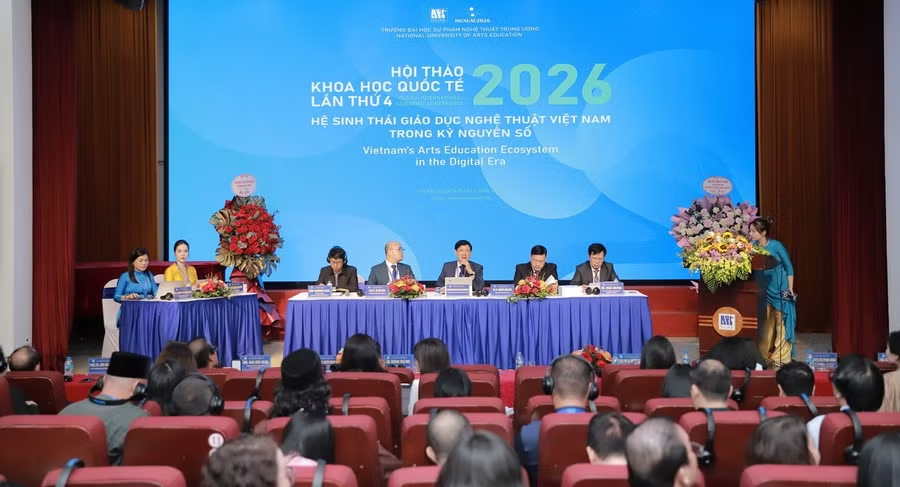
The event was part of a series of activities marking the 56th anniversary of the university’s establishment (November 7, 1970-November 7, 2026), attracting a large number of domestic and international scientists, educators and artists.
In his directive remarks at the conference, Associate Professor and Doctor Bui Hoai Son, Deputy Head of the Party Central Committee’s Commission for Publicity, emphasised that, amid digital transformation, arts education faces numerous opportunities to access knowledge, expand creative spaces and disseminate cultural values. However, technology should be used as a supporting tool and cannot replace humanistic values, artistic sensibility or the teacher’s role in inspiring learners. Therefore, importance must be attached to building an aesthetic foundation, nurturing cultural identity and helping learners master technology without losing the nation’s core values.

“A music lesson, a first painting or a teacher’s encouragement can sow the seeds of a love of beauty, awaken creativity and help shape learners’ character. In the digital era, students need to be equipped with the ability to master technology while retaining their capacity to appreciate beauty, their attachment to their roots and their national cultural identity,” Associate Professor and Doctor Bui Hoai Son shared.
In his opening remarks and introductory address, Meritorious Teacher, Associate Professor and Doctor Dao Dang Phuong, Secretary of the Party Committee and Rector of the university, who also chaired the Organising Committee, emphasised the need to reform arts education amid digital transformation. Referring to Resolutions No. 57-NQ/TW, 71-NQ/TW and 80-NQ/TW of the Politburo, he affirmed: “Reforming training on the basis of science, technology and digital transformation, while preserving and promoting the system of cultural values and standards of the Vietnamese people, is a requirement facing arts education today.”

According to Associate Professor and Doctor Dao Dang Phuong, digital technology has become deeply embedded in artistic creative activities. Generative artificial intelligence (AI) can produce images, arrange music and write lyrics in a short time; students have also begun using these tools in their assignments and projects. This raises a series of new issues for training institutions, including determining copyright ownership of works involving AI, establishing regulations on the use of technology, reforming assessment methods and ensuring academic integrity.
The Rector of the National University of Arts Education noted that a training institution could hardly address issues relating to infrastructure, learning materials, heritage data, copyright and creative outputs on its own without coordination among multiple stakeholders. The ecosystem needs to connect universities, lecturers and learners with artists, artisans, management agencies, museums, theatres, creative businesses, communities that hold cultural heritage and international partners. Resources relating to training programmes, learning materials, technology, data and finance need to be interconnected and mutually supportive.

From the perspective of education management and international cooperation, Associate Professor and Doctor Nguyen Thu Thuy, Director General of the Department of International Cooperation under the Ministry of Education and Training, spoke highly of the progress made by the National University of Arts Education in expanding its partnerships. Accordingly, in 2025, the university carried out 22 cooperation activities with partners from 10 countries, signed six new cooperation agreements and participated in numerous training projects meeting international standards.
With a plenary session and three parallel thematic sessions, the conference provided a forum for exchanges between Vietnamese scientists and international scholars. The Organising Committee said it had received more than 170 papers, of which 145 were selected, edited and included in the conference proceedings, covering three fields: culture and arts, music, and fine arts. The papers were contributed by authors from numerous prestigious academies, universities, research institutes and training institutions across the country.

The papers focused on topical and practical issues, ranging from the application of digital learning materials and AI in training, teaching and artistic creation to the preservation, inheritance and promotion of the values of traditional cultural heritage, including Xoan singing, Quan ho folk songs, Vi and Giam folk singing, Cheo traditional opera, Hat boi (classical opera), Cai luong (reformed theatre) and the folk dances of ethnic minority groups…
When heritage materials are digitised and incorporated into lessons, learners have greater opportunities to explore, practise and create on the basis of national culture. This also provides a foundation for connecting training with cultural industry products. In addition, issues concerning copyright, professional ethics and transparency in the application of AI were also addressed, reflecting the new requirements facing arts training and creative activities today.
Specifically, at the Culture and Arts session, presenters focused on issues relating to educational reform in association with the development of cultural industries, the preservation and promotion of heritage values, artists’ rights and cultural competence in the context of integration.
The Music session addressed the application of technology in the research, teaching and preservation of traditional music; the role of AI in supporting vocal training and musical theatre; and creative approaches to contemporary music practice.
The Fine Arts and Applied Arts session focused on the impact of generative AI on graphic design training, the preservation of cultural identity in digital creativity, image ethics and the reform of calligraphy teaching methods.

Scholars from China, the Republic of Korea, Japan, India, Laos, Malaysia and Thailand also contributed perspectives and practical approaches to training cooperation, technology application and artistic exchanges in the region. The experiences shared demonstrated that arts education needs to be situated within a broad network of connections, enabling knowledge, learning materials, teaching methods and creative resources to be regularly exchanged among training institutions.
The practical experiences and proposals put forward at the conference are expected to serve as the basis for policy recommendations, training programmes and cooperation models, contributing to the development of a modern, distinctive and internationally integrated arts education ecosystem in Viet Nam.